EP20K400EFC672-2 Altera, EP20K400EFC672-2 Datasheet - Page 30
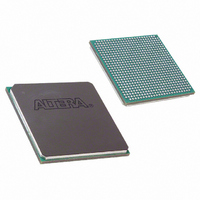
EP20K400EFC672-2
Manufacturer Part Number
EP20K400EFC672-2
Description
IC APEX 20KE FPGA 400K 672-FBGA
Manufacturer
Altera
Series
APEX-20K®r
Datasheet
1.EP20K30ETC144-3.pdf
(117 pages)
Specifications of EP20K400EFC672-2
Number Of Logic Elements/cells
16640
Number Of Labs/clbs
1664
Total Ram Bits
212992
Number Of I /o
488
Number Of Gates
1052000
Voltage - Supply
1.71 V ~ 1.89 V
Mounting Type
Surface Mount
Operating Temperature
0°C ~ 85°C
Package / Case
672-FBGA
Lead Free Status / RoHS Status
Contains lead / RoHS non-compliant
Available stocks
Company
Part Number
Manufacturer
Quantity
Price

Company:
Part Number:
EP20K400EFC672-2N
Manufacturer:
ALTERA
Quantity:
240
Company:
Part Number:
EP20K400EFC672-2X
Manufacturer:
ALTERA
Quantity:
586
Part Number:
EP20K400EFC672-2X
Manufacturer:
ALTERA/阿尔特拉
Quantity:
20 000
Company:
Part Number:
EP20K400EFC672-2XB
Manufacturer:
ALTERA
Quantity:
3 000

APEX 20K Programmable Logic Device Family Data Sheet
30
ESBs can implement synchronous RAM, which is easier to use than
asynchronous RAM. A circuit using asynchronous RAM must generate
the RAM write enable (WE) signal, while ensuring that its data and address
signals meet setup and hold time specifications relative to the WE signal.
In contrast, the ESB’s synchronous RAM generates its own WE signal and
is self-timed with respect to the global clock. Circuits using the ESB’s self-
timed RAM must only meet the setup and hold time specifications of the
global clock.
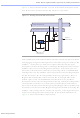
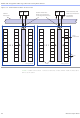
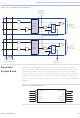
ESB inputs are driven by the adjacent local interconnect, which in turn can
be driven by the MegaLAB or FastTrack Interconnect. Because the ESB can
be driven by the local interconnect, an adjacent LE can drive it directly for
fast memory access. ESB outputs drive the MegaLAB and FastTrack
Interconnect. In addition, ten ESB outputs, nine of which are unique
output lines, drive the local interconnect for fast connection to adjacent
LEs or for fast feedback product-term logic.
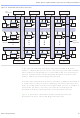
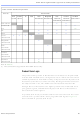
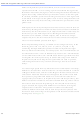
When implementing memory, each ESB can be configured in any of the
following sizes: 128 × 16, 256 × 8, 512 × 4, 1,024 × 2, or 2,048 × 1. By
combining multiple ESBs, the Quartus II software implements larger
memory blocks automatically. For example, two 128 × 16 RAM blocks can
be combined to form a 128 × 32 RAM block, and two 512 × 4 RAM blocks
can be combined to form a 512 × 8 RAM block. Memory performance does
not degrade for memory blocks up to 2,048 words deep. Each ESB can
implement a 2,048-word-deep memory; the ESBs are used in parallel,
eliminating the need for any external control logic and its associated
delays.
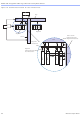
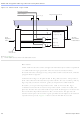
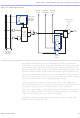
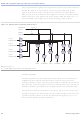
To create a high-speed memory block that is more than 2,048 words deep,
ESBs drive tri-state lines. Each tri-state line connects all ESBs in a column
of MegaLAB structures, and drives the MegaLAB interconnect and row
and column FastTrack Interconnect throughout the column. Each ESB
incorporates a programmable decoder to activate the tri-state driver
appropriately. For instance, to implement 8,192-word-deep memory, four
ESBs are used. Eleven address lines drive the ESB memory, and two more
drive the tri-state decoder. Depending on which 2,048-word memory
page is selected, the appropriate ESB driver is turned on, driving the
output to the tri-state line. The Quartus II software automatically
combines ESBs with tri-state lines to form deeper memory blocks. The
internal tri-state control logic is designed to avoid internal contention and
floating lines. See
Figure
18.
Altera Corporation
Related parts for EP20K400EFC672-2
Image
Part Number
Description
Manufacturer
Datasheet
Request
R

Part Number:
Description:
CYCLONE II STARTER KIT EP2C20N
Manufacturer:
Altera
Datasheet:


Part Number:
Description:
CPLD, EP610 Family, ECMOS Process, 300 Gates, 16 Macro Cells, 16 Reg., 16 User I/Os, 5V Supply, 35 Speed Grade, 24DIP
Manufacturer:
Altera Corporation
Datasheet:
Part Number:
Description:
CPLD, EP610 Family, ECMOS Process, 300 Gates, 16 Macro Cells, 16 Reg., 16 User I/Os, 5V Supply, 15 Speed Grade, 24DIP
Manufacturer:
Altera Corporation
Datasheet:
Part Number:
Description:
Manufacturer:
Altera Corporation
Datasheet:
Part Number:
Description:
CPLD, EP610 Family, ECMOS Process, 300 Gates, 16 Macro Cells, 16 Reg., 16 User I/Os, 5V Supply, 30 Speed Grade, 24DIP
Manufacturer:
Altera Corporation
Datasheet:
Part Number:
Description:
High-performance, low-power erasable programmable logic devices with 8 macrocells, 10ns
Manufacturer:
Altera Corporation
Datasheet:
Part Number:
Description:
High-performance, low-power erasable programmable logic devices with 8 macrocells, 7ns
Manufacturer:
Altera Corporation
Datasheet:
Part Number:
Description:
Classic EPLD
Manufacturer:
Altera Corporation
Datasheet:
Part Number:
Description:
High-performance, low-power erasable programmable logic devices with 8 macrocells, 10ns
Manufacturer:
Altera Corporation
Datasheet:
Part Number:
Description:
Manufacturer:
Altera Corporation
Datasheet:
Part Number:
Description:
Manufacturer:
Altera Corporation
Datasheet:
Part Number:
Description:
Manufacturer:
Altera Corporation
Datasheet:
Part Number:
Description:
CPLD, EP610 Family, ECMOS Process, 300 Gates, 16 Macro Cells, 16 Reg., 16 User I/Os, 5V Supply, 25 Speed Grade, 24DIP
Manufacturer:
Altera Corporation
Datasheet: