EP20K400EFC672-2 Altera, EP20K400EFC672-2 Datasheet - Page 37
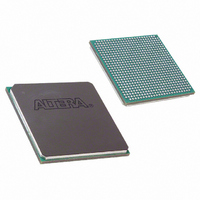
EP20K400EFC672-2
Manufacturer Part Number
EP20K400EFC672-2
Description
IC APEX 20KE FPGA 400K 672-FBGA
Manufacturer
Altera
Series
APEX-20K®r
Datasheet
1.EP20K30ETC144-3.pdf
(117 pages)
Specifications of EP20K400EFC672-2
Number Of Logic Elements/cells
16640
Number Of Labs/clbs
1664
Total Ram Bits
212992
Number Of I /o
488
Number Of Gates
1052000
Voltage - Supply
1.71 V ~ 1.89 V
Mounting Type
Surface Mount
Operating Temperature
0°C ~ 85°C
Package / Case
672-FBGA
Lead Free Status / RoHS Status
Contains lead / RoHS non-compliant
Available stocks
Company
Part Number
Manufacturer
Quantity
Price

Company:
Part Number:
EP20K400EFC672-2N
Manufacturer:
ALTERA
Quantity:
240
Company:
Part Number:
EP20K400EFC672-2X
Manufacturer:
ALTERA
Quantity:
586
Part Number:
EP20K400EFC672-2X
Manufacturer:
ALTERA/阿尔特拉
Quantity:
20 000
Company:
Part Number:
EP20K400EFC672-2XB
Manufacturer:
ALTERA
Quantity:
3 000

APEX 20K Programmable Logic Device Family Data Sheet
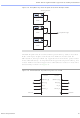
Implementing Logic in ROM
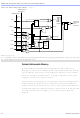
In addition to implementing logic with product terms, the ESB can
implement logic functions when it is programmed with a read-only
pattern during configuration, creating a large LUT. With LUTs,
combinatorial functions are implemented by looking up the results, rather
than by computing them. This implementation of combinatorial functions
can be faster than using algorithms implemented in general logic, a
performance advantage that is further enhanced by the fast access times of
ESBs. The large capacity of ESBs enables designers to implement complex
functions in one logic level without the routing delays associated with
linked LEs or distributed RAM blocks. Parameterized functions such as
LPM functions can take advantage of the ESB automatically. Further, the
Quartus II software can implement portions of a design with ESBs where
appropriate.
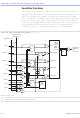
Programmable Speed/Power Control
APEX 20K ESBs offer a high-speed mode that supports very fast operation
on an ESB-by-ESB basis. When high speed is not required, this feature can
be turned off to reduce the ESB’s power dissipation by up to 50%. ESBs
that run at low power incur a nominal timing delay adder. This
TM
Turbo Bit
option is available for ESBs that implement product-term
logic or memory functions. An ESB that is not used will be powered down
so that it does not consume DC current.
Designers can program each ESB in the APEX 20K device for either
high-speed or low-power operation. As a result, speed-critical paths in the
design can run at high speed, while the remaining paths operate at
reduced power.
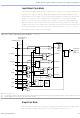
I/O Structure
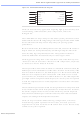
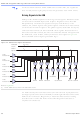
The APEX 20K IOE contains a bidirectional I/O buffer and a register that
can be used either as an input register for external data requiring fast setup
times, or as an output register for data requiring fast clock-to-output
performance. IOEs can be used as input, output, or bidirectional pins. For
fast bidirectional I/O timing, LE registers using local routing can improve
setup times and OE timing. The Quartus II software Compiler uses the
programmable inversion option to invert signals from the row and column
interconnect automatically where appropriate. Because the APEX 20K IOE
offers one output enable per pin, the Quartus II software Compiler can
emulate open-drain operation efficiently.
The APEX 20K IOE includes programmable delays that can be activated to
ensure zero hold times, minimum clock-to-output times, input IOE
register-to-core register transfers, or core-to-output IOE register transfers.
A path in which a pin directly drives a register may require the delay to
ensure zero hold time, whereas a path in which a pin drives a register
through combinatorial logic may not require the delay.
Altera Corporation
37
Related parts for EP20K400EFC672-2
Image
Part Number
Description
Manufacturer
Datasheet
Request
R

Part Number:
Description:
CYCLONE II STARTER KIT EP2C20N
Manufacturer:
Altera
Datasheet:


Part Number:
Description:
CPLD, EP610 Family, ECMOS Process, 300 Gates, 16 Macro Cells, 16 Reg., 16 User I/Os, 5V Supply, 35 Speed Grade, 24DIP
Manufacturer:
Altera Corporation
Datasheet:
Part Number:
Description:
CPLD, EP610 Family, ECMOS Process, 300 Gates, 16 Macro Cells, 16 Reg., 16 User I/Os, 5V Supply, 15 Speed Grade, 24DIP
Manufacturer:
Altera Corporation
Datasheet:
Part Number:
Description:
Manufacturer:
Altera Corporation
Datasheet:
Part Number:
Description:
CPLD, EP610 Family, ECMOS Process, 300 Gates, 16 Macro Cells, 16 Reg., 16 User I/Os, 5V Supply, 30 Speed Grade, 24DIP
Manufacturer:
Altera Corporation
Datasheet:
Part Number:
Description:
High-performance, low-power erasable programmable logic devices with 8 macrocells, 10ns
Manufacturer:
Altera Corporation
Datasheet:
Part Number:
Description:
High-performance, low-power erasable programmable logic devices with 8 macrocells, 7ns
Manufacturer:
Altera Corporation
Datasheet:
Part Number:
Description:
Classic EPLD
Manufacturer:
Altera Corporation
Datasheet:
Part Number:
Description:
High-performance, low-power erasable programmable logic devices with 8 macrocells, 10ns
Manufacturer:
Altera Corporation
Datasheet:
Part Number:
Description:
Manufacturer:
Altera Corporation
Datasheet:
Part Number:
Description:
Manufacturer:
Altera Corporation
Datasheet:
Part Number:
Description:
Manufacturer:
Altera Corporation
Datasheet:
Part Number:
Description:
CPLD, EP610 Family, ECMOS Process, 300 Gates, 16 Macro Cells, 16 Reg., 16 User I/Os, 5V Supply, 25 Speed Grade, 24DIP
Manufacturer:
Altera Corporation
Datasheet: